Last Updated on: 3rd October 2026, 02:28 pm
To check if a business name is already taken in the U.S., search your state’s official business entity database, then check the USPTO trademark database, DBA records, search engines, domain names, and relevant social media platforms. A name can appear available in a state registry and still conflict with an existing trademark or business.
Did you know that U.S. trademark applicants filed more than 824,000 new trademark classes in fiscal year 2025, a 7.4% increase from the previous year? That makes a broader name search important, because the exact name may be available while a similar trademark already exists in the same market.
What Does It Mean When a Business Name Is “Taken”?
A business name can be unavailable in several different ways.
For example, another company may already have registered the name as an LLC or corporation in your state. The name may also conflict with an existing trademark, be used as a DBA by another business, or already belong to an established brand that has been using it commercially. These checks are not interchangeable.
The U.S. Small Business Administration distinguishes four common types of business-name registration: an entity name, trademark, DBA, and domain name. Each serves a different purpose. An entity name is generally connected to state registration, while a federal trademark protects branding rights at the national level.
So, checking only your Secretary of State database is not enough if you plan to build a serious brand around the name.
How to Check if a Business Name Is Taken
Use the following seven-step process before registering a business name, buying branding materials, or launching a website.
- Search Your State’s Business Entity Database
Start with the state where you plan to form your business.
Most states provide an online database where you can search existing LLCs, corporations, partnerships, and other registered business entities. These databases are usually managed by the Secretary of State or another state business agency.
The National Association of Secretaries of State maintains a directory of state corporate registration pages and business-name databases, making it a useful starting point if you are unsure where your state’s official search tool is located.
Suppose you want to start a company called:
Blue Harbor Creative LLC
Do not search only the complete name. Try several versions, such as:
- Blue Harbor Creative
- Blue Harbor
- Harbor Creative
- Blue Harbour
- Blue Harbor Creatives
Removing “LLC,” “Inc.,” or similar business suffixes can help uncover names that are already registered in a slightly different form.
Your state’s database can tell you whether another registered entity has an identical or similar name, but the final decision about whether a proposed entity name is acceptable belongs to the state filing authority.
- Search Similar Spellings and Variations
One of the most common mistakes when doing a business name search is looking only for an exact match.
If your proposed name is Bright Peak Labs, another company might already be operating as:
- BrightPeak Labs
- Bright Peaks
- Bright Peak Laboratory
- Bright Peek Labs
- Bright Peak Technologies
Search the distinctive portion of your business name separately.
Also check:
- Singular and plural versions
- Alternate spellings
- Common misspellings
- Abbreviations
- Words joined together or separated
- Similar-sounding names
Finding a similar business does not automatically mean your name cannot be used. However, it tells you that more research is needed before registering it.
- Search the USPTO Trademark Database
After checking state records, search the United States Patent and Trademark Office Trademark Search system.
This step matters because business registration and trademark rights are separate.
The National Association of Secretaries of State specifically notes that registering a business name does not establish trademark rights and does not guarantee that the same name is available for trademark use.
The USPTO provides its current Trademark Search system for checking registered and pending federal trademarks. Older guides may refer to TESS, but the USPTO now directs users to its newer Trademark Search system.
Search your exact proposed business name first.
Then search similar:
- Words
- Spellings
- Pronunciations
- Meanings
- Brand variations
This is important because trademarks do not need to be identical to create a potential conflict.
According to the USPTO, trademarks can be considered confusingly similar based on their sound, appearance, meaning, or overall commercial impression. The relationship between the goods or services offered by the businesses also matters.
For example, changing one letter in a business name does not automatically make it safe.
When reviewing trademark results, pay attention to:
- Whether the trademark is live
- Whether an application is still pending
- What products or services it covers
- Who owns it
- How similar it sounds or looks to your proposed name
If you discover a close trademark used for related products or services, consider getting professional trademark advice before investing heavily in the name.
- Check DBA and Assumed-Name Records
Not every business operates under its legal company name.
A company may use a:
- DBA, or “doing business as” name
- Assumed name
- Trade name
- Fictitious business name
For example, a company legally registered as Miller Holdings LLC might operate publicly as Bright Bean Coffee.
If you search only for Miller Holdings, you could miss the name customers actually know.
DBA registration requirements differ by location. Depending on where the business operates, a DBA may be registered with the state, county, or city.
The SBA notes that DBA requirements can vary based on state, county, municipality, and business structure.
If your business will serve a particular city or local market, check local DBA or assumed-name databases as part of your research.
Business Name Search by State

The government office responsible for business registrations varies by state. In many states it is the Secretary of State, but several states use another agency.
Here is a quick reference for where to begin your business name search:
| State | Main Business Registration Authority |
| Alabama | Secretary of State |
| Alaska | Division of Corporations, Business and Professional Licensing |
| Arizona | Arizona Corporation Commission |
| Arkansas | Secretary of State |
| California | Secretary of State |
| Colorado | Secretary of State |
| Connecticut | Secretary of State |
| Delaware | Division of Corporations |
| Florida | Division of Corporations / Sunbiz |
| Georgia | Secretary of State |
| Hawaii | Business Registration Division |
| Idaho | Secretary of State |
| Illinois | Secretary of State |
| Indiana | Secretary of State / INBiz |
| Iowa | Secretary of State |
| Kansas | Secretary of State |
| Kentucky | Secretary of State |
| Louisiana | Secretary of State |
| Maine | Secretary of State |
| Maryland | Department of Assessments and Taxation |
| Massachusetts | Secretary of the Commonwealth |
| Michigan | Department of Licensing and Regulatory Affairs |
| Minnesota | Secretary of State |
| Mississippi | Secretary of State |
| Missouri | Secretary of State |
| Montana | Secretary of State |
| Nebraska | Secretary of State |
| Nevada | Secretary of State |
| New Hampshire | Secretary of State |
| New Jersey | Department of the Treasury |
| New Mexico | Secretary of State |
| New York | Department of State |
| North Carolina | Secretary of State |
| North Dakota | Secretary of State |
| Ohio | Secretary of State |
| Oklahoma | Secretary of State |
| Oregon | Secretary of State |
| Pennsylvania | Department of State |
| Rhode Island | Department of State |
| South Carolina | Secretary of State |
| South Dakota | Secretary of State |
| Tennessee | Secretary of State |
| Texas | Secretary of State |
| Utah | Division of Corporations and Commercial Code |
| Vermont | Secretary of State |
| Virginia | State Corporation Commission |
| Washington | Secretary of State |
| West Virginia | Secretary of State |
| Wisconsin | Department of Financial Institutions |
| Wyoming | Secretary of State |
Because state websites and portals can change, use the official state government website or the NASS corporate registration directory to reach the current database.
- Search Google and Other Online Sources
The next step is a broader internet search.
Search your proposed name in quotation marks:
“Blue Harbor Creative”
Then combine it with relevant terms:
- “Blue Harbor Creative” design
- “Blue Harbor Creative” California
- “Blue Harbor” marketing agency
- “Blue Harbor Creative” business
Look beyond the first few results.
Check for:
- Business websites
- Google Business Profiles
- Online directories
- Marketplace stores
- Professional profiles
- Apps
- Local companies
- News articles
- Industry listings
Why does this matter?
A company does not necessarily need a federal trademark registration for its existing commercial use to matter.
The USPTO recommends conducting broader clearance research beyond the federal trademark database because other uses of a mark may need to be considered.
Therefore, finding no matching USPTO record does not automatically mean nobody is using the name.
- Check Whether the Domain Name Is Available
A strong business name is much easier to build online when you can secure a suitable domain.
For example, if your business is called Blue Harbor Creative, you might look for:
- blueharborcreative.com
- blueharbor.com
- blueharborstudio.com
A taken domain does not necessarily mean the business name itself is unavailable.
Someone may have registered the domain without creating a company or trademark around it.
Similarly, an available domain does not prove that the business name is legally available.
The SBA treats domain registration separately from entity names and trademarks.
For checking registration data, it is also useful to know that domain lookup technology has changed. ICANN made the Registration Data Access Protocol, or RDAP, the definitive source for generic top-level domain registration information beginning January 28, 2025, replacing the traditional WHOIS protocol for this purpose.
If your ideal .com is taken, check what is actually using it before giving up on the business name.
An active competitor using the same brand is far more important than an unused domain registered years ago.
- Check Social Media Names
Search the name on the platforms that matter to your future business.
Depending on your audience, that may include:
- TikTok
- YouTube
- X
Ideally, your branding should be reasonably consistent across your website and social profiles.
However, a taken social handle does not automatically make a business name unavailable.
For example, if @blueharborcreative is already taken, you may still be able to use:
- @blueharborstudio
- @blueharborco
- @blueharborcreativeUS
What matters more is who owns the existing account.
If another active business in your industry is already using the same name across a website and several social platforms, investigate the potential conflict carefully before moving forward.
How to Tell Whether Your Search Results Are a Problem
Not every matching result means you have to abandon your name.
Use this simple framework.
Green Light: No Obvious Conflict
Your preliminary search looks promising when:
- No identical state entity appears
- No obvious conflicting live trademark appears
- No established company in your industry is using the name
- A suitable domain is available
- Reasonable social handles are available
This still does not guarantee legal clearance, but it gives you a stronger starting point.
Yellow Light: More Research Needed
Investigate further if you find:
- A dissolved business with the same name
- The same name registered in another state
- A similar trademark used for different products
- A similar-sounding brand
- An inactive website using the name
- A business with similar wording in another industry
These situations often depend on context.
For example, discovering the same business name in another state does not automatically answer whether you can use it. State registration rules, trademark rights, location, industry, and customer confusion can all matter.
Red Light: Take the Conflict Seriously
Be cautious when:
- Your state says the entity name is unavailable
- An active company already uses the same name in your market
- A live trademark closely resembles your name and covers related goods or services
- Customers could reasonably believe your business is connected to another existing brand
The USPTO says likelihood of confusion is a common reason trademark applications are refused. Two marks do not need to be identical for confusion to exist.
Does an Available LLC Name Mean You Can Use the Business Name?
Not necessarily.
This is one of the most important distinctions to understand.
A state may allow you to register an LLC name because it satisfies that state’s entity-naming rules. That does not automatically mean another company has no trademark rights in the same or a similar name.
Business-name registration and trademark rights are separate.
NASS specifically warns that obtaining a business name registration does not establish trademark rights or eliminate the possibility that another party could object to the name.
Therefore:
State availability tells you whether the name may be available for entity registration. Trademark clearance helps determine whether using that name as a brand could conflict with another mark.
For a small local business, your research needs may be relatively straightforward. If the name will support a national company, ecommerce brand, franchise, software product, or substantial marketing investment, a more comprehensive trademark clearance search becomes much more important.
Can Two Businesses Have the Same Name?
In some circumstances, yes.
Two businesses may use the same or similar words without necessarily creating a trademark conflict, particularly when they operate in unrelated industries or markets.
The key issue is often whether consumers are likely to believe that the businesses, products, or services come from the same source.
For trademark purposes, the USPTO considers both the similarity of the marks and the relationship between the goods or services.
For example, two businesses using a similar word for completely unrelated products may present a different situation from two competing businesses offering the same service under nearly identical names.
State entity-name rules also differ, so always check the requirements of the state where you plan to register.
What if the Business Name You Want Is Already Taken?
Your best response depends on what type of conflict you find.
If Another Company Has the State Entity Name
Create a more distinctive variation and search again.
Instead of making a tiny change such as adding punctuation, consider adding a meaningful word.
For example:
Taken: Summit Creative LLC
Possible alternatives:
- Summit Grove Creative
- Summit North Studio
- Summit Lane Design
A stronger difference can make the new name easier to distinguish and easier to brand.
If You Find a Similar Trademark
Do not assume changing one letter will solve the problem.
For example:
Brightly and Britelee
may look different on paper but could still sound similar.
The USPTO evaluates similarities in appearance, sound, meaning, and commercial impression, along with the relationship between the goods and services.
If the potential conflict involves an important brand in a related industry, consider professional trademark advice.
If Only the Domain Is Taken
You may still have options.
Try:
- A sensible shortened version
- Adding your service
- Adding a geographic term when appropriate
- Contacting the owner about purchasing the domain
Avoid spending heavily on a domain until you have completed your business-name and trademark checks.
Owning the domain does not automatically give you trademark rights to the name.
If the Social Handle Is Taken
Choose a simple brand variation.
A social username is mainly a branding concern unless the account reveals another business already using the same brand.
Business Name Availability Checklist
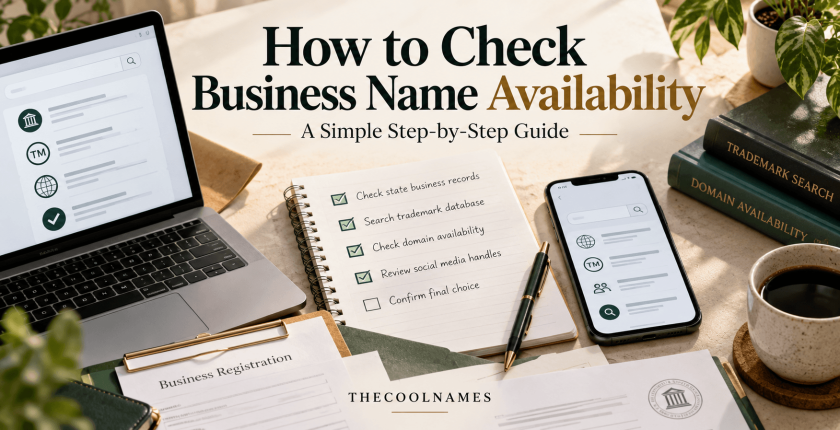
Before deciding that your business name is available, complete these checks:
- Search your state’s official business entity database.
- Search the main words without “LLC,” “Inc.,” or other suffixes.
- Search alternative spellings and similar-sounding names.
- Search the USPTO Trademark Search system.
- Review similar trademarks used for related goods or services.
- Search relevant DBA or assumed-name databases.
- Search Google and other online sources for existing commercial use.
- Check your preferred domain and practical alternatives.
- Search relevant social media platforms.
- Investigate any close matches before registering or investing heavily in the brand.
A clean result across all of these checks gives you much more useful information than relying on a single “business name availability” search.
Frequently Asked Questions
How do I check if a business name is already taken?
Start by searching your state’s official business entity database. Then search the USPTO trademark database, relevant DBA records, Google, domains, and social platforms. Checking several sources is important because entity registration, trademarks, DBAs, and domains are separate.
Is my business name available if it does not appear in the state database?
Not necessarily. Another business could have trademark rights or be using the name commercially even if it does not appear as an identical registered entity in your state.
Can I use a business name that exists in another state?
Possibly, but the answer depends on state registration rules, trademarks, your industry, location, and whether the use could create customer confusion. Finding the same name in another state should trigger further research rather than an automatic yes or no.
Can two LLCs have the same name?
Business entity naming rules vary by state. Similar names may sometimes exist in different states, but trademark rights and other legal issues can still affect whether a name can safely be used as a brand.
Does registering an LLC protect my business name nationwide?
No. State entity registration and federal trademark protection are separate. The SBA explains that entity-name registration generally operates at the state level, while trademark registration can provide federal protection.
Should I search only for exact trademark matches?
No. Search similar spellings, pronunciations, meanings, and commercial impressions. The USPTO explains that trademarks can be confusingly similar without being identical.
What if a company with the same name is dissolved?
Do not automatically assume the name is available. States have different rules concerning inactive or dissolved entities, and previous commercial or trademark rights may still matter. Check your state’s current requirements before registering it.
Is checking a business name free?
Many preliminary checks can be done for free through official state databases, the USPTO Trademark Search system, search engines, and domain-registration lookup tools. Professional legal or comprehensive trademark clearance services may involve additional costs.
Final Words
Checking whether a business name is already taken requires more than typing the name into one search box. Start with your state’s official business registry, but do not stop there. Check federal trademarks, DBA records, existing commercial use, domains, and the social platforms that matter to your brand. Most importantly, remember this distinction:
A business name can be available for state registration without being completely clear for trademark or brand use.
This article provides general educational information and should not be considered legal advice.

The Cool Names is regularly providing the name and nickname ideas for games, social media, pets and people. A group of highly qualified and experienced writers finds the perfect names and give tips and ideas about name ideas and related topics here at this blog. Follow us for unique name and nickname ideas on a daily basis.